Showing posts with label a. Show all posts
Showing posts with label a. Show all posts
Thursday, April 4, 2013
Making a Time Machine Concept Explored
Wondering how to travel in time? Learn it with great Sir Stephen Hawking, according to whom time warp may be an option but seems pretty impractical, the reason being the feed back loop which will just oppose the feasibility of making a time machine and the concept using this theory.
Are you intrigued by the stories of "time travel." Then probably you are looking for a blueprint to build a time machine. The guidelines presented by sir Stephen Hawking regarding a time machine would certainly help you out.
Building a Time Machine
According to Stephen Hawking time walk seems hypothetically feasible using a wormhole. Wormhole in simple words may be described as a short-cut passage into the future or into the past of one’s life. However, Hawking says that even if it becomes a reality in the near future, one drastic contradiction will never allow time walk possible especially moving into the past. A highly contradictory aspect called the feedback loop will just oppose the happening and make the phenomenon impossible. As the name suggests, feedback loop may be explained as an occurrence of a negative looping that would oppose or cancel out the phenomenon from taking place or from flourishing.
Consider for a second that you have a time machine and use it to travel a couple of years back in time. You see yourself in the past (two years ago). However, you think of a weird experiment and try killing yourself in the past. Using a pistol your present form shoots your past. But the moment your past form is killed your “present” instantly ceases to exist! ……….but that’s absurd, if you are already killed two years back then who was this “you” who killed you in the past? This “looping” becomes very contradictory and convincingly opposes the possibility of wormhole time walk theory.
However, to build a time machine for travelling into the future though sounds pretty unreal, the various calculations involved has definitely produced some intriguing and positive results.
Stephen Hawking says that gravity plays an important role in slowing down time (this baffles me), the greater the mass of an object rather a heavenly body, the slower time moves in its vicinity. Just as the speed of water flow is different at different positions in a river or a water canal, the speed of time may also be different around different masses, depending upon its size and weight.
We all know about the ancient pyramids, they are massive, weighing more than 80 million kgs. The huge mass astonishingly slows down time around it compared to places which are far away from it (again baffling). Surprisingly, people situated very close to the pyramid will see far away things moving rather swiftly compared to things which are around them or the pyramid.
Next page unravels more facts that would help us to build a time machine.
Time Machine and Speed of Light
The highly illusive thought regarding how to travel in time using a time machine never stops our scientists from delving into newer fascinations and experiments. Let’s read on:
The fact that mass affects time speed is exactly the reason why our satellites which are relatively away from earth than us experiences a difference in the speed of time (albeit very marginal) and requires constant setting.
On the basis of the above theory, Stephen Hawking assumes that it can be quite possible to put a halt in your aging process by travelling in space around something that may awesomely huge in mass.
In the future if scientists succeed in making superfast airships that would carry them quickly to our nearest black hole (weighing 4 million times greater than our sun), then surely once they reach close to it (and circle it for a certain calculated times and then return to earth, for the astronauts the passage of time would show probably just the half than what has passed on earth – they have landed in the future world on earth.
Another assumption by Stephen Hawking states that if we move almost at the speed of light (which is the fastest figure yardstick existing in universe) we can slow down time around us drastically (never understood this).
In a classic example Stephen Hawking fantasizes a truly intriguing set-up. Suppose a super advanced railway track is built encircling the earth end-to-end. Hopefully we also build a train and make it to run over this track at a speed quite close to the speed of light (because quantum physics states that says nothing can equal speed of light).
Now suppose after some calculated revolutions the train comes to a halt. The passengers come out of the train and are astonished to witness a world that’s probably moved a 100 years ahead in the future, that’s because time inside the train moved about 100 times slower than outside it on earth due to its proximity to the speed of light.
Another baffling aspect that would occur is: physical laws would never allow the passengers to run even at their normal speeds inside the train while it was in motion, simply because that would make their overall speed on earth greater than the speed of light (boggling stuff).
Everything inside the train would happen in a rather slow-motion (time warped).
Seems quite remote though, let’s hope our near future finds a solution and positively solves our quest regarding how to make a time machine.

Tuesday, March 26, 2013
How to Make a Capacitive Discharge Ignition
How to Make a Capacitive Discharge Ignition (CDI) Circuit for Two-Wheelers
The ignition process in any vehicle becomes the heart of the entire system as without this stage the vehicle just won’t start. To initiate the process, earlier we use to have the circuit breaker unit for the required actions.
Nowadays a more efficient and long lasting mechanism has been developed for the ignitions in vehicles, called the capacitor discharge ignition system. It incorporate an electronic circuit precisely functions like the old contact breaker, but in a solid-state electronic manner.
Let’s learn the circuit operations with the following points:
Basically as the name suggest, ignition system in vehicles refers to the process in which the fuel mixture is ignited for initiating the engine and the drive mechanisms.
This ignition is done through an electrical process by generating high voltage electrical arcs.
The above electrical arc is created through extreme high voltage passage across two potentially opposite conductors through the enclosed air gap.
As we all know that for generating high voltages we require some kind of stepping up process, generally done through transformers.
As the source voltage available in two wheeler vehicles is from an alternator, may not be powerful enough for the functions.
Therefore the voltage needs to be stepped up many thousand folds in order to reach the desired arcing level.
The ignition coil, which is very popular and we all have seen them in our vehicles is especially designed for the above stepping up of the input source voltage
However the voltage from the alternator cannot be directly fed to the ignition coil because the source may be low in current, therefore we employ a CDI unit or a capacitive discharge unit for collecting and releasing the alternator power in succession in order to make the output compact and high with current.
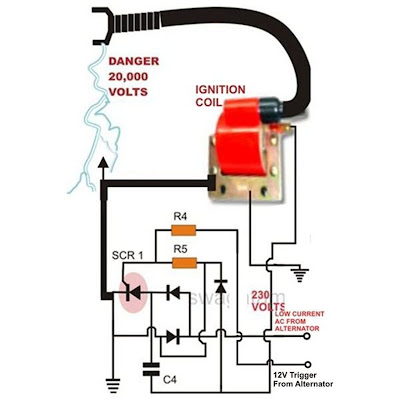
Referring to the above capacitor discharge ignition circuit diagram, we see a simple configuration consisting of a few diodes, resistors, a SCR and a single high voltage capacitor.
The input to the CDI unit is derived from two sources of the alternator.
One source is a low voltage around 12 volts while the other input is taken from the relatively high voltage tap of the alternator, generating around a 100 volts.
The 100 volts input is suitably rectified by the diodes and converted to 100 volts DC. This voltage is stored inside the high voltage capacitor instantaneously.
The low 12 voltage signal is applied to the triggering stage and used for triggering the SCR.
The SCR responds to the half wave rectified voltage and switches the capacitors ON and OFF alternately.
Now since the SCR is integrated to the ignition primary coil, the released energy from the capacitor is forcibly dumped in the primary winding of the coil.
The action generates a magnetic induction inside the coil and the input from the CDI which is high in current and voltage is further enhanced to extremely high levels at the secondary winding of the coil.
The generated voltage at the secondary of the coil may rise up to the level of many tens of thousands of volts.
This output is appropriately arranged across two closely held metal conductors inside the spark plug.
The voltage being very high in potential starts arcing across the points of the spark plug, generating the required ignition sparks for the ignition process.
Parts List for the CIRCUIT DIAGRAM
R4 = 56 Ohms,
R5 = 100 Ohms,
C4 = 1uF/250V
SCR = BT151 recommended.
All Diodes = 1N4007
Coil = Standard two-wheeler ignition Coil
Subscribe to:
Posts (Atom)